
Operations

Transshipment System
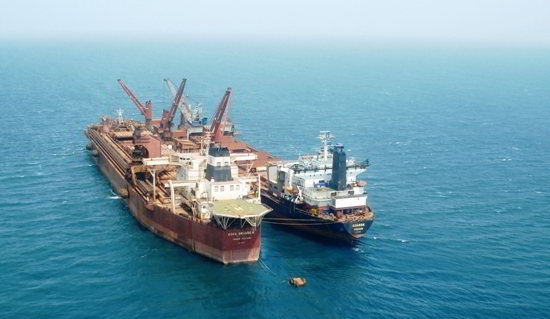
The Transshipment System is the fundamental element supporting CVG Ferrominera Orinoco’s iron ore export program, serving customers located in Europe and Asia.
It is composed of three Venezuelan‑flag vessels:
- The transshipment station Boca Grande II
- The self‑unloading carrier M/V Río Orinoco
- The self‑unloading carrier M/V Río Caroní
The system operates in four stages:
- Loading
- Transport
- Unloading and storage
- Loading of export vessels
Navigation is carried out through the Orinoco River navigation channel and the Atlantic Ocean up to the Boca Grande II Transshipment Station, located at the mouth of the Macareo Channel near the Gulf of Paria.
The distance from Ferrominera’s port to Boca Grande II is 293 nautical miles, and 178 nautical miles from the Punta Barima pilot station to Ferrominera’s port.
The river draft varies seasonally:
- 32 feet during low‑water season (January–February)
- 44 feet during high‑water season (August–September)
This variation directly affects the performance of the hauling system. Depending on the available draft, vessels can be loaded to different tonnages:
- At 32 ft draft, vessels can load up to 46,000 tons of iron ore
- At 44 ft draft, vessels can load up to 74,000 tons
Draft varies along each segment of the navigation channel according to the loading table of the M/V Río Caroní.
The Transshipment System is designed to transport 6,000,000 metric tons per year, as summarized below:
Requirements for Dispatching 6 Million Tons of Iron Ore
- Annual transported tonnage: 6,000,000 tons
- Number of vessels: 2
- Tonnage hauled per vessel per trip: 50,000 tons
- Trips per vessel per month: 5
- Total trips per vessel per year: 60
- Voyage cycle time: 6 days
Boca Grande II Transshipment Station
The station is equipped with a self‑unloading conveyor system with a rate between 5,000 and 6,000 tons/hour. It is fitted with four deck‑mounted cranes for unloading iron ore from non‑self‑unloading vessels at a rate of 35,000 tons/day.
The station can transfer iron ore to export vessels regardless of their size (length or beam), without requiring additional positioning maneuvers (mooring alongside), provided the vessel’s deadweight tonnage (DWT) is 180,000 tons or less.
The station operates under four loading/unloading modes:
Mode I
Self‑unloading vessels deliver ore through the boom conveyor into the starboard receiving hopper. The ore is then transferred to the cross‑conveyor and subsequently to the boom conveyor, which moves longitudinally along the port side to load the station’s holds.
Mode II
Ore is delivered as in Mode I, but simultaneously transferred directly to the export vessel while also loading the station’s holds.
Mode III
Non‑self‑unloading carriers moor on the starboard side of the station and are unloaded using four electro‑hydraulic cranes. Ore is placed into the station’s holds and later transferred to export vessels as in Mode I.
Mode IV
The station unloads ore stored in its holds using its conveyor‑based cargo‑handling system. Ore is discharged through 81 hydraulic gates onto longitudinal conveyors (three aft, three forward), then transferred to the cross‑conveyor, lifted by the lift‑conveyor, and finally sent to the boom conveyor for loading into export vessel holds.
Vessel Characteristics
Boca Grande II is a self‑unloading and self‑loading vessel, converted from an OBO to a bulk carrier, with barge‑storage class notation. It has a static storage capacity of 120,000 tons and a nominal unloading rate of 6,000 t/h.
The Río Orinoco and Río Caroní are Panamax self‑unloading vessels with River Service class notation. They deliver ore to Boca Grande II at approximately 2,500 t/h through Hopper 1. With maximum draft, these vessels haul 50,000 tons, and with minimum draft, 32,000 tons.
Ferrominera Orinoco Wharves
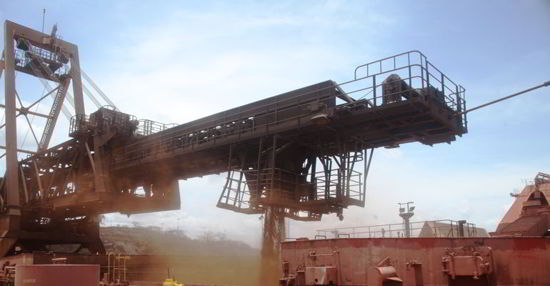
CVG Ferrominera Wharf
Located at mile 184 of the Caroní River navigation channel. Characteristics:
- Wharf type: 5 barges suspended on piles
- Length: 570 m
- Width: 25 m
- Depth (high water): 14 m
- Depth (low water): 10 m
- Maximum loading capacity: 6,000 t/h
Palúa Wharf
Located at mile 182 of the Caroní River navigation channel. Characteristics:
- Wharf type: 2 barges suspended on piles
- Length: 276 m
- Width: 21 m
- Depth (high water): 13 m
- Depth (low water): 9 m
- Maximum loading capacity: 1,500 t/h
Shortcuts